
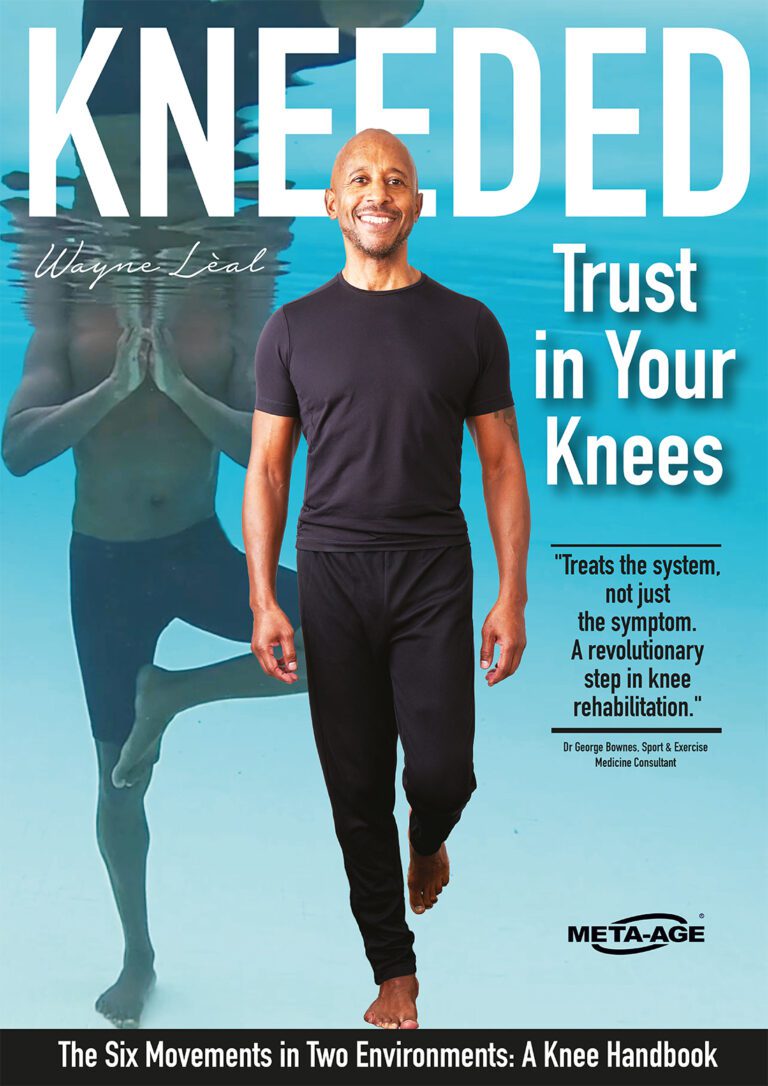
Changing the way we think about knee pain
Most books on knee pain begin with damage.
They focus on scans, diagnoses, and isolated strengthening exercises designed to “fix” a joint that’s already been labelled as failing. Whether the subject is arthritis, ligament injury, or post-surgical rehab, the assumption is the same:
the knee is the problem.
KNEEDED begins somewhere else.
It asks a simpler, more confronting question:
What if knees fail functionally long before they fail structurally?
Written as a practical handbook, KNEEDED is designed to be used—not just read.
Authored by Wayne Lèal, founder of Meta-Age and creator of the JUMPGA and KunAqua systems, the handbook draws on decades of movement teaching and lived experience with bone-on-bone knees and multiple surgeries. Instead of chasing perfect joints, it focuses on restoring something more important:
trust.
Loss of trust is what truly limits people. When the body no longer trusts the knee to stabilise, decelerate, or adapt under load, movement becomes guarded. Confidence drops. Compensation patterns take over. Activity shrinks.
Traditional programmes often miss this because they train strength in isolation.
KNEEDED treats the knee as part of a system—shaped by foot contact, hip control, trunk stability, timing, and coordination. Rather than dozens of exercises tied to specific diagnoses, the handbook introduces six universal movement patterns that underpin functional knee health.
Those patterns are trained through two complementary environments.
On land, JUMPGA uses controlled instability to force real-time neuromuscular engagement. The body can’t cheat. Stabilisers must respond. Trust is rebuilt through intelligent challenge.
In water, KunAqua uses buoyancy and resistance to reduce threat while keeping the knee involved. Movement slows. Momentum disappears. Control returns without impact.
This isn’t about being gentler.
It’s about being smarter.
KNEEDED doesn’t promise repair or reject medicine. Surgery may still be necessary. Damage may still exist. But between diagnosis and intervention—and long after—there is a critical window where intelligent movement can preserve function, confidence, and independence.
That’s where KNEEDED lives.
In a crowded landscape of knee books that look impressive but feel disconnected from real life, KNEEDED stands apart for one reason:
it treats people, not parts.